
Apprenticeship in the construction sector is undergoing an unprecedented phase of tension. Constructys financed 88,126 apprenticeship contracts in 2025, compared to 93,447 the previous year, marking a decline of 6%. This drop, concentrated on CAP level certifications, raises questions about the sector’s ability to renew its skilled workforce. Understanding the concrete mechanisms of apprenticeship training in construction trades allows us to measure what this pathway truly offers, beyond the usual promotional discourse.
Apprenticeship contract in construction: what the June 2025 decrees change
Decrees n° 2025-585 and n° 2025-586 of June 27, 2025, have reduced the funding levels for diplomas higher than the baccalaureate. Professional bachelor’s, master’s, or engineering programs in alternating training within the construction sector see their employer funding reduced. This change directly impacts companies’ decisions to host an apprentice beyond level 4.
For CAP and professional certificate level training, funding remains stable. Operational trades on construction sites maintain a favorable financial framework for hiring apprentices. This is a crucial point for candidates aiming for masonry, roofing, plumbing, or electricity: the residual cost for the employer remains manageable, facilitating the signing of the contract.
Training organizations like Bâtiment CFA assist companies in the administrative setup of these contracts, a concrete lever in the face of the increasing complexity of funding mechanisms.
Decline in CAP numbers: why construction trades are losing apprentices
About 60% of apprenticeship contracts in construction involve level 3 certifications (CAP and equivalents). It is precisely these contracts that are eroding the most. The decline is not uniform: it affects the heavy construction and roofing trades more than those related to energy performance, driven by renovation demand.

Several factors explain this decline:
- The economic context of the sector hinders hiring. Craft businesses, which train the majority of construction apprentices, reduce their commitments when the order book contracts.
- The competition from tertiary sectors attracts some potential candidates. Apprenticeship training in digital or logistics fields benefits from a more valued image, rightly or wrongly.
- The gap between site conditions (physical work, weather, travel) and the expectations of some young audiences remains a structural barrier that the sector struggles to overcome.
Constructys links this evolution to a deferred risk: the shortage of operational skills will fully manifest in two to three years, when retirements are no longer compensated.
Skills acquired in construction CFA compared to the school pathway
Apprenticeship training in construction is not limited to a school-site alternation. The time spent in the company represents the majority of the training, resulting in a skill profile that is radically different from that of a student in a traditional school pathway.
An apprentice in CAP masonry, after two years, has handled materials on real sites, managed supplies, and worked under the responsibility of a team leader. They understand the rhythms, the constraints of coordination between trades, and the safety standards applied (and not just theoretical).
The full-time school curriculum includes internships, but these remain short. The gap is mainly measured on three points:
- Reading plans in real situations, with the inaccuracies and adaptations that any construction site imposes, as opposed to calibrated academic exercises.
- Management of equipment and consumables, an invisible skill in a reference framework but crucial for autonomy on site.
- Client relations, which construction apprentices experience early on, particularly in craft businesses working with private individuals.
We observe that employers in the sector clearly favor profiles from apprenticeship during post-graduation recruitment. The accumulated experience in the company during training is the primary selection criterion, ahead of the grade obtained in the exam.
Remuneration and actual cost of an apprentice in the construction sector
The remuneration of the apprentice in construction follows the legal scale indexed to the minimum wage, with variations depending on age and year of contract. This salary, often perceived as an advantage by the candidate, also represents a cost for the employer, partially offset by hiring aids and the coverage of the educational cost by the OPCO Constructys.
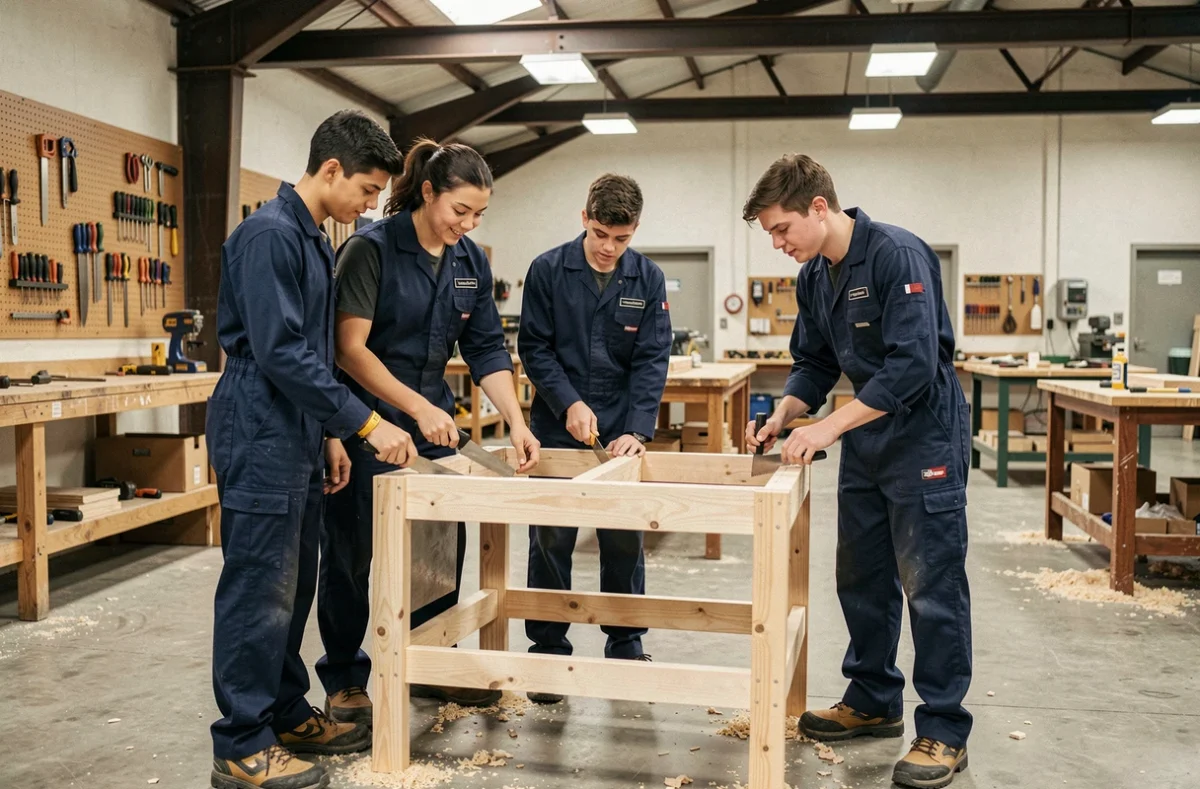
The actual cost for a craft business exceeds just the gross remuneration. It is necessary to include the time spent on tutoring (a mentor mobilized several hours a day), the tools provided, the renewed personal protective equipment, and the reduced productivity during the first months. The return on investment becomes tangible from the second year of the contract, when the apprentice reaches a sufficient level of autonomy in routine tasks.
For candidates, remuneration during training prevents student debt and allows for a gradual entry into working life. This economic model remains one of the strongest arguments for apprenticeship in construction trades, provided that the volume of contracts offered by companies is maintained.
The recent decline in the number of apprentices in construction does not invalidate the model. It signals a cyclical contraction of supply, not a structural disinterest from employers in this training pathway. The construction trades that recruit apprentices remain among those with the highest insertion rates after graduation. For a candidate ready to commit to a construction site, the apprenticeship contract remains the shortest path to qualified employment.